
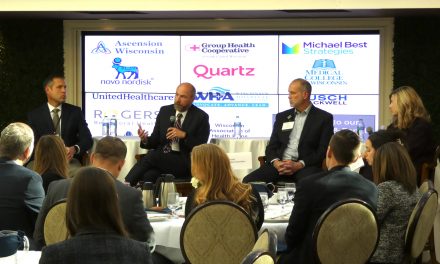




How are competition, consolidation and transparency affecting healthcare costs?

Healthcare industry stakeholders talked about how competition, consolidation and transparency are affecting healthcare costs during a Wisconsin Health News event Tuesday in Madison.
Edited excerpts from the event are below.
WHN: What are insurers doing to address costs?
John Nygren, Wisconsin Association of Health Plans CEO: Making sure it’s the appropriate care in the appropriate setting at the appropriate cost. Utilization management and preventative care, those are the types of things that we can invest in and actually reduce those overall costs.
The other thing I would say is that Wisconsin is unique — special quite honestly — and hopefully people here appreciate it. The competitive market that we have here in Wisconsin with the number of health insurance players is unique to any other Midwestern state. You go to any one of our neighbors, there’s one or two carriers that control the market. That’s not the case. I have 12 HMOs that I represent and four MCOs. Our 12 HMOs represent 60 percent of the commercial market. It takes 12 of them to get to that point. That shows you how competitive Wisconsin is.
Competition matters in a lot of segments. I’ll take a little shot at my friend Sean here: It matters in the (pharmacy benefit manufacturer) market. When three PBMs control 80 percent of the market, that is a problem too. Competition will drive down costs.
WHN: Do you agree that having just three large PBMs is adversely affecting cost?
Sean Stephenson, senior director of state affairs at the Pharmaceutical Care Management Association: The metric is correct, approximately three companies process 80 percent of claims. Now within that, that means only one PBM is roughly covering about 29 percent. That shouldn’t be glazed over so lightly.
There is a lot of competition in the PBM space. There are over 70 PBMs throughout the country. Some are niche in the services that they provide. As the entity that provides prescription drug benefits for employers, governments and our union members, if they put out an RFP, those 70 companies will sharpen their pencils to get that business. When our members respond to an RFP, it’s no different. They are going to put their best price forward and hopefully get that business … Employers use a PBM because we provide cost savings. If we didn’t, there’d be no reason for us.
WHN: Wisconsin’s health systems are becoming consolidated, and evidence shows that can increase costs by decreasing competition and negotiation power. Is that happening in the state?
Dr. Mark Cockley, senior vice president of population health for the north region of Froedtert ThedaCare: As we’ve come together as an organization, now that we have the ability to provide about every aspect of healthcare, where you have critical access hospitals, home care, community hospitals, a trauma center, an academic center, we have the ability to improve our process. We’ve learned a lot from each other of doing things in the rural community versus in the inner city in Milwaukee, and how we can leverage that care and improve the quality and decrease the cost.
WHN: Not much is known about why certain drug prices go up and why. Why is transparency lacking?
Peter Fotos, deputy vice president of state advocacy at Pharmaceutical Research and Manufacturers of America: The pharmaceutical industry certainly supports transparency as a whole. The problem that we have is when we try and analyze just that aspect of it, the pricing aspect from the manufacturer, it doesn’t provide a whole lot of help to a consumer or a patient on understanding anything. They need to understand that it starts from the lab all the way to the medicine cabinet.
So talking just about rebates and pricing concessions, we start with the list price on a drug. That’s where the negotiation begins. Those rebates are anywhere between 16 and 73 percent … I don’t think dollar for dollar, it’s helpful to understand what the rebate is. We always ask for aggregate and broad strokes: What is happening with those rebates, and where are they ending up?
And this gets into the vertical integration of healthcare. The top three PBMs also own insurers or are also owned by insurers, or they own their own pharmacies, the way that CVS does. Some of them own physician groups, specialty pharmacies, mail-order pharmacies and so on and so forth. Understanding where the money is getting driven to and from throughout the whole supply chain is much more useful.
WHN: What impact do you think more transparency can have on cost?
Raj Shukla, state director at AARP Wisconsin: Transparency is always going to help consumers have more options and make a more informed choice.
But our focus at AARP is a lot less on the systemic friction that we’ve listened to here, and a lot more on the downstream impact to families. What we know is that families are increasingly having to turn to other family members to care for themselves, as opposed to going into a healthcare system or seeing a doctor. That means families are taking on, on average, $7,200 of unpaid care for relatives or loved ones. That is something that as a system, as a society, we think that we should be supporting families in that way.
There are absolutely economic issues. There are industry issues that should be addressed. But, in terms of people, we would like to see support for caregivers who are at home, often without training and certainly without any financial support, and who are taking on a lot and basically performing the role of the healthcare system right now.
This article first appeared in the Wisconsin Health News daily email newsletter. Sign up for your free trial here.